

Home » Case studies » Case study – Edu Intelligence
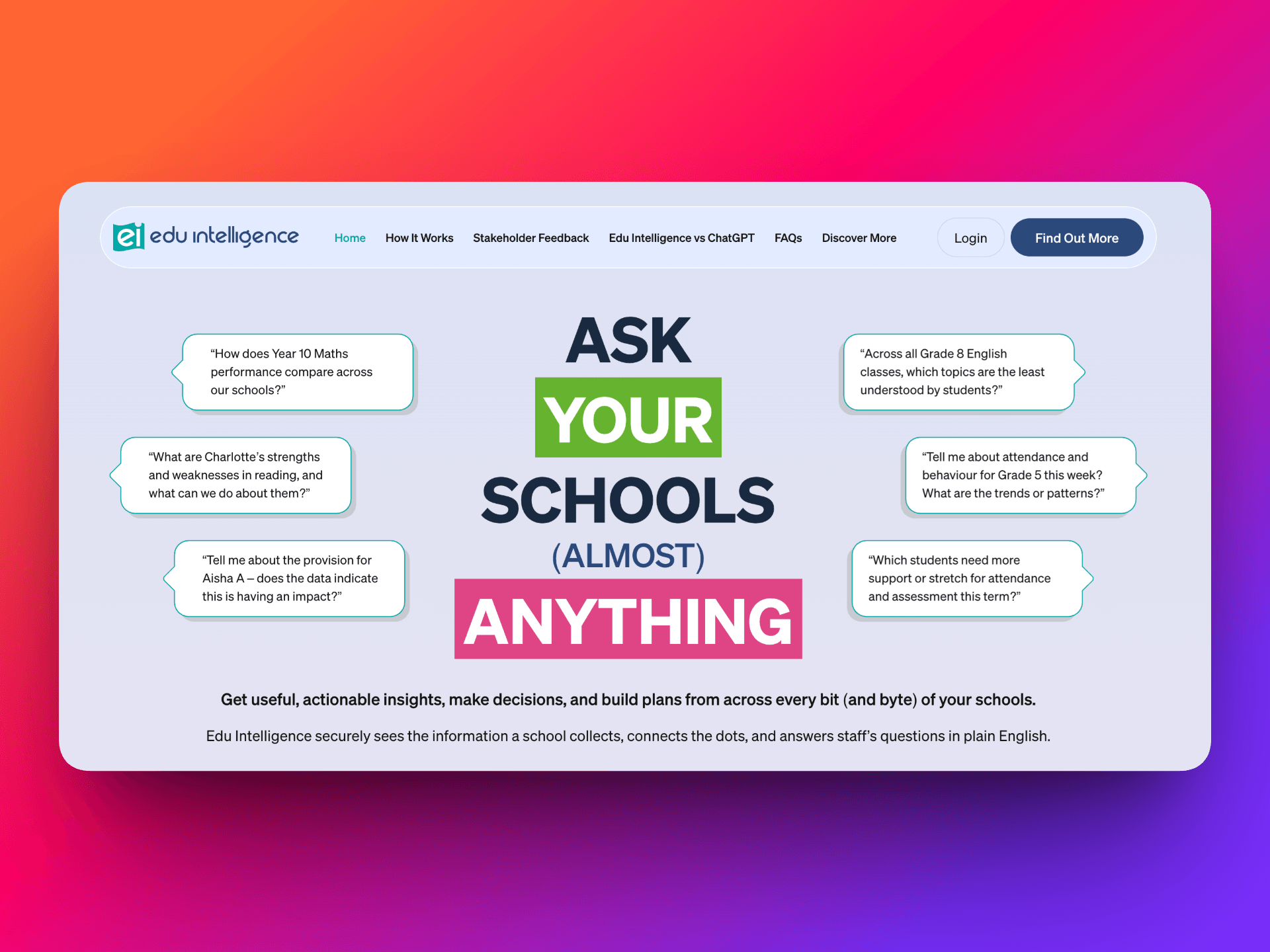
Ask your school (almost) anything
From a data platform in search of a market, to an award and investment winning AI school decision platform.
Edu Intelligence had a remarkable, AI native platform that could significantly improve the professional lives of senior leaders.
But technology-led messaging made a powerful product feel complex, generic, and difficult to understand.


Edu Intelligence is a decision intelligence layer for schools and trusts. It plugs into the information a school already has and uses AI to let leaders ask it questions in plain English.
The Challenge
Edu Intelligence came to Bee Digital for a new value proposition and a messaging refresh. What they got was more of a strategic reset: category, positioning, buyer profiles, narrative architecture, and everything downstream.
Overall, Edu Intelligence wanted to reposition itself away from “survey tool with AI analysis” and towards a clearer decision intelligence proposition.
But that proposition had to be made plain, role-specific, and rooted in real school problems because the education market will only buy when value feels easy to understand, low-risk, and immediately relevant.
The Strategy
The product wasn't the problem. The story was.
Every school leader is already drowning in tools that promised to “connect your data” or “give you actionable insights” or “save teacher time”.
The market had trained teaching teams to hear anything data-adjacent as “another dashboard” – and that’s the opposite of what Edu Intelligence was.
Positioning Edu Intelligence as a better version of what schools already had was going to lose before it started.
But at the heart of the product was a simple, magical proposition: its specially built AI meant staff could ask their school any question and get a meaningful answer based on their actual data and info.
All messaging must answer the question: "So what does this mean for my school / Trust?"
So instead of interviewing buyers about features, we asked about the operational and pedagogical questions they were struggling to answer – the ones that came up in SLT meetings, headteacher reports, inspection prep, and pastoral reviews, and never quite got a good or easy answer because the information was spread across different systems, a shared drive, and various email threads.
We noticed three important things that reshaped our approach:
- One product, multiple buyers. Trust and group leaders, school senior leaders, and specialist leads (SENCOs, inclusion, safeguarding, data) were all using Edu Intelligence but for very different reasons, with very different questions, and very different measures of success. Trying to speak to all of them at once, as if they were “one customer” was flattening the message for everyone. We split them into distinct buyer profiles and mapped the questions each one actually asks their data on any given week.
- Overwhelming data wasn’t a problem that could be solved by being better with data. School leaders didn’t need to be convinced that information fragmentation was a problem. That was their daily reality.
- The demo did the selling. Once a leader saw Edu Intelligence answer a real question in plain English, using their own data, in seconds… they got it.
The outcome
Stop selling features. Start selling questions.
Edu Intelligence had mostly been telling the market how it worked. But that approach was also the reason the story was being interpreted by schools as “just another data tool”.
We saw that, in reality, this was an ‘opportunity cost’ challenge.
Every time a teacher spends time doing one thing, they’re not doing something else. Opportunity cost is the value of that “something else” you had to give up. In schools, it’s often about what staff could be doing if they weren’t stuck on low-value data admin.
Every school leader already knows what they’re not getting to. The question “what could your senior team be doing instead?” isn’t abstract to them.
That’s what makes opportunity cost different from the other value levers. It doesn’t require the buyer to trust a techie explanation. It just asks them to acknowledge something they already know is true.
So we moved the story one layer up. Away from the tech, and onto what it lets a school leader do that they’ve never been able to do before: ask their school a question, and get an evidenced answer back in seconds.
That reframe stopped Edu Intelligence competing with dashboards and MIS bolt-ons, and gave it its own category to lead: decision intelligence for school and trust leaders.
It shifted the tone of the marketing from technical explanation to leadership-to-leadership.
The new exciting one-line proposition became: “Ask your school (almost) anything.”
Underneath it, a strategic frame the whole business could work from – the always-on, always-reliable advisor between a school’s information and its leadership decisions.
From there, messaging architecture, website structure, sales collateral, pitch decks, campaign angles, had a spine to build against.
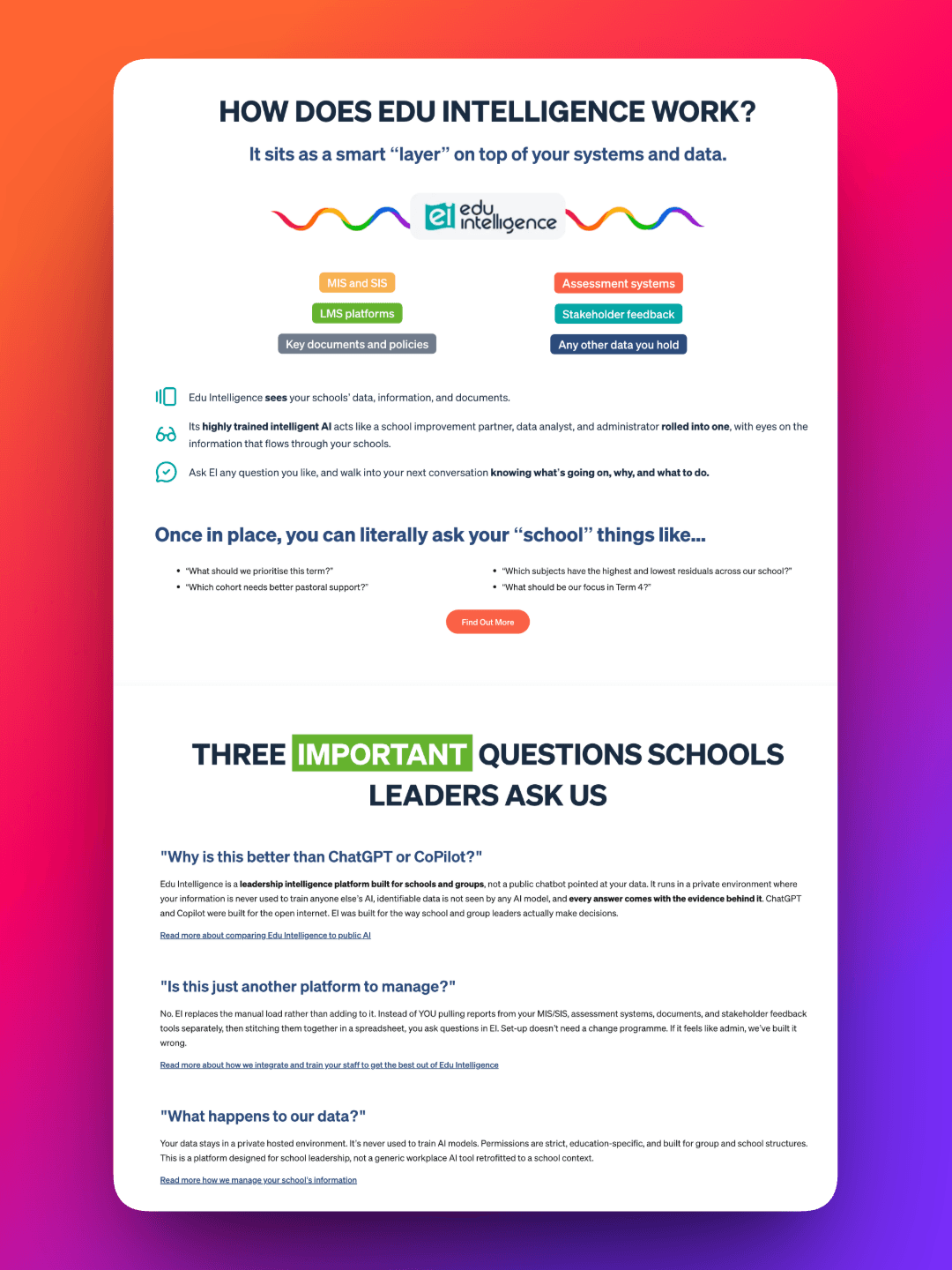
How the strategy shaped the work
Current marketing snapshot
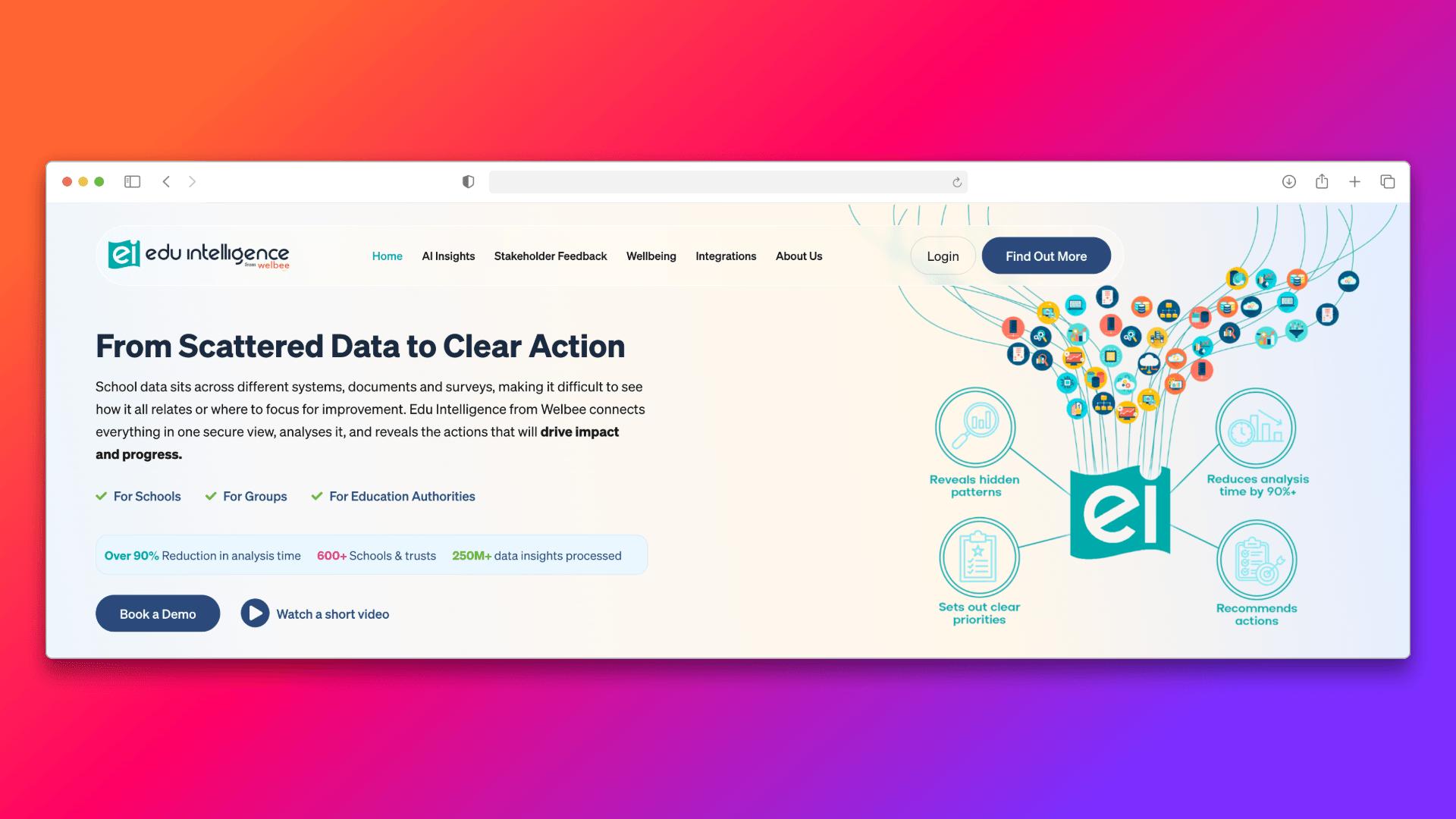
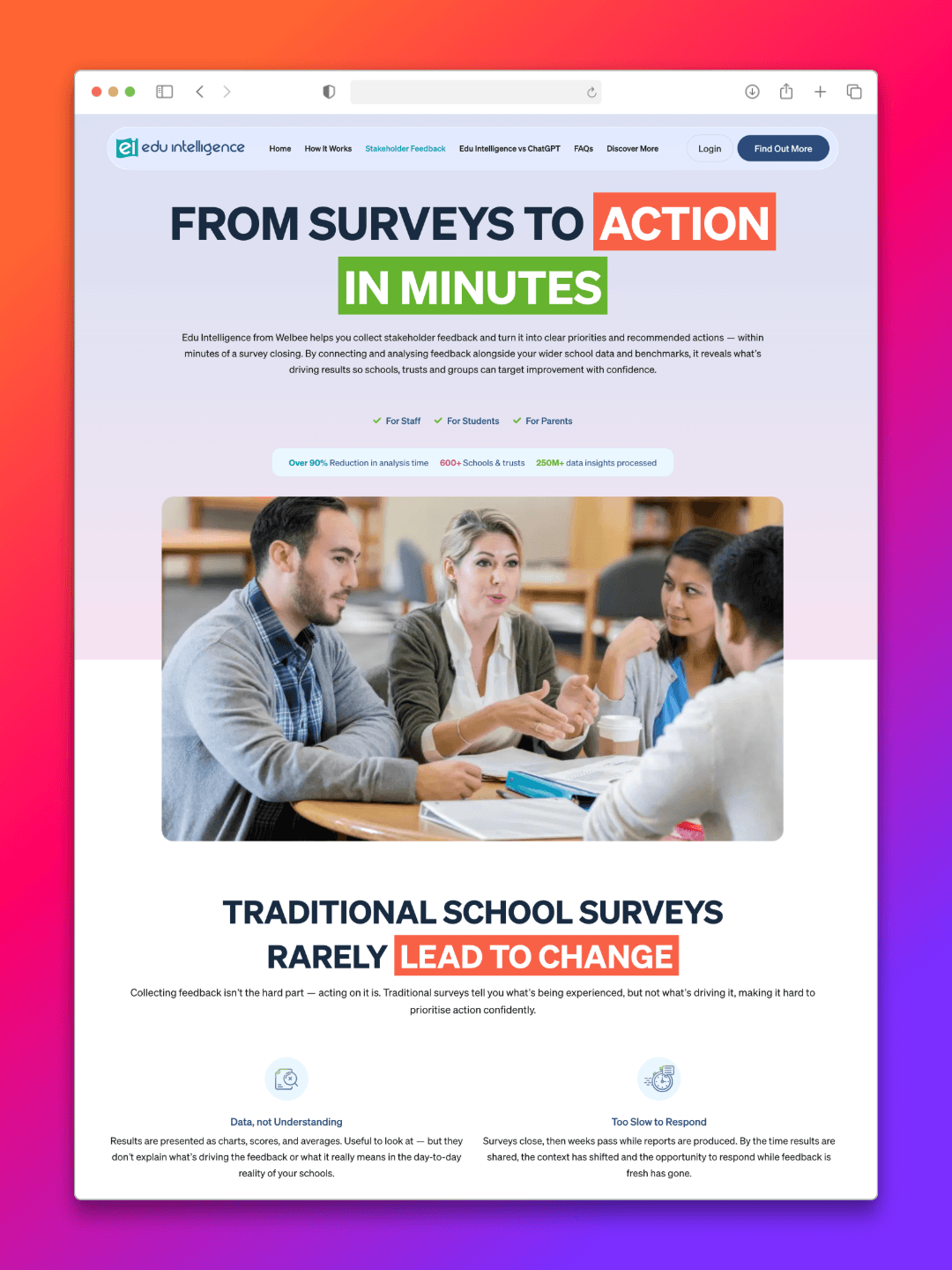
A hard look at what the website, decks, LinkedIn, and sales collateral were actually saying and how teachers might see it. The snapshot showed Edu Intelligence being read as “a dashboard with AI on top” or “a survey tool.” Both were wrong, and both were being reinforced by the client’s own materials.
Value proposition and messaging architecture
One hero line -“Ask your school (almost) anything” – sitting above three ICP-specific interpretations.
Use cases and impact stories
35+ unique teacher focused use cases were developed. Each one was written as a real school scenario and how Edu Intelligence sat within it, so a potential customer reading it recognises their own week.
Sales toolkit and pitch deck
A new pitch deck built, so the story a prospect reads online is the story they hear. Plus objection handling, buyer-profile-specific talk tracks, and pre-empts for conversations that were killing deals such as “We’ve already got ChatGPT” and “What about our data lead?”
Email nurture series
A sequence written to earn the demo. Each email built around one leader question, one use case, one piece of practitioner proof. No “here’s what our AI can do.” The goal was to get the reader curious enough to want to see it live.
What we deliberately didn’t do
- Lead with AI. Every competitor was doing it. The AI is the how, not the why.
- Lead with efficiency. Time saved and cost reduced are middle-of-funnel supporting points. Efficiency framing puts Edu Intelligence in the admin-tool area.
- Explain the tech on the homepage. Integrations, security, and data architecture matter but not right away.
- Speak to teachers. The buyer is a Head, a CEO, a Curriculum Director. The tone had to be leadership-to-leadership. Anything that sounded like teacher-productivity copy got cut.

The result
- A brand new value proposition strategy that gives Edu Intelligence a unique voice in a rapidly growing and highly competitive segment.
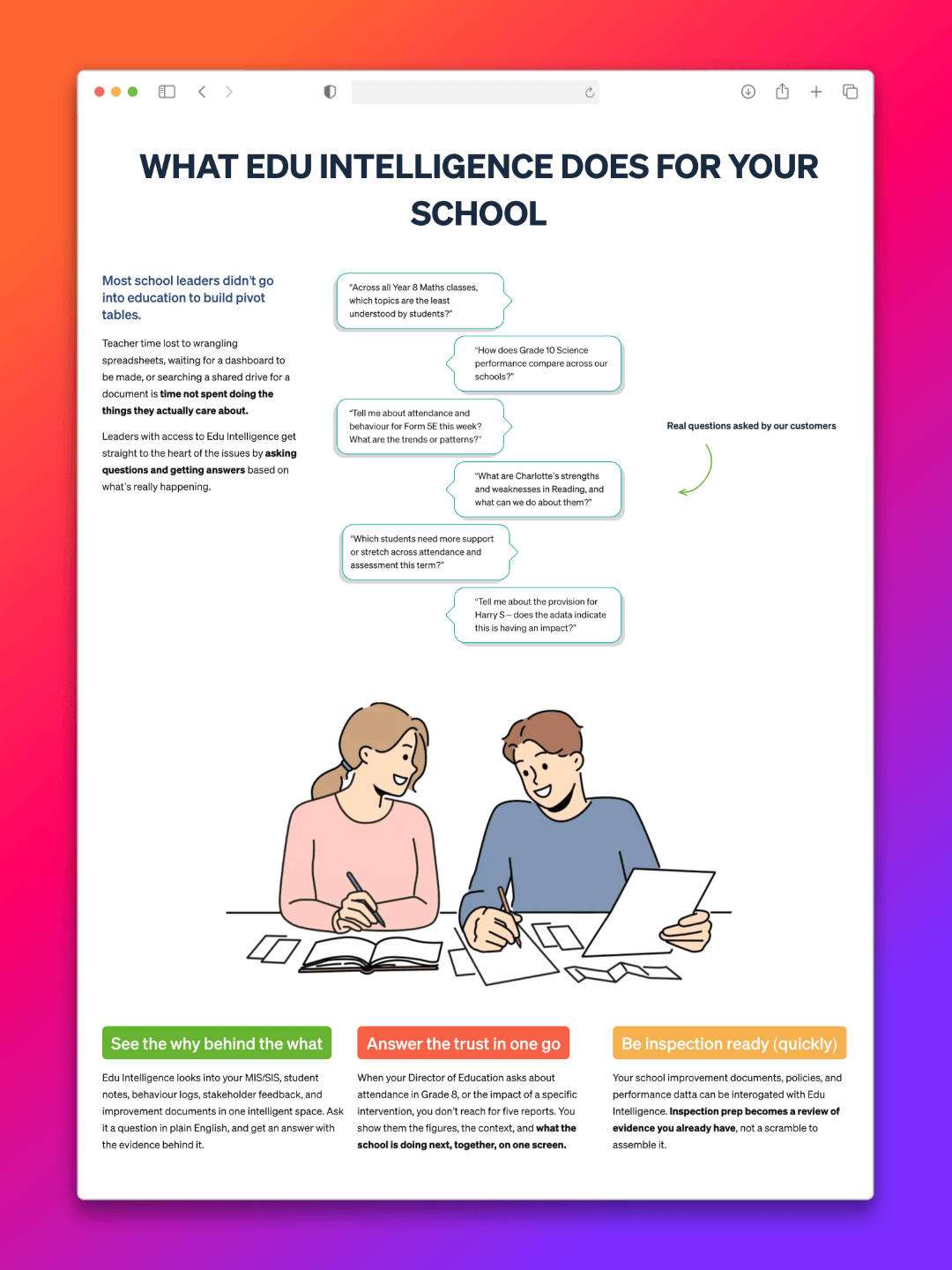
- A completely overhauled website that opens with the questions school leaders actually ask, puts the value front and centre, and uses language focused on making it easy for MAT leaders to see the benefit for their schools and staff.
- A branding framework that can be used in every asset, deck, and channel.
Edu Intelligence have since won ‘BESA – Best use of AI in Education 2026’ and been acquired by the Faira Group.
Ready to grow your education business? 😎