

Social proof matters. Everyone agrees on that. Five-star testimonials. Logos. Quotes. Screenshots. The lot.
And yet, if you spend any time reviewing education supplier websites, landing pages, sales decks, or onboarding emails like we do, you start to notice something odd.
There is usually a decent amount of social proof. But very little of it actually does any hard work.
It sits there. Polite. Vague. Interchangeable.
“Great product.”
“Really supportive team.”
“Would recommend to other schools.”
Fine, I guess. But not telling a compelling story for your target customers.
This is not because social proof does not matter in education. Quite the opposite. In complex, risk-averse, procurement-heavy markets like schools and trusts, it matters more than in most sectors.
The issue is how it is used, who it comes from, and what job the endorsement is supposed to do in the buyer’s mind.
If you’re a Marketing Manager who already believes in the power of social proof but wants it to actually change buyer behaviour you might to up your social proof game.
The real role of social proof in edtech buying decisions
Before we talk tactics, it is worth grounding this in how schools buy. Many purchases that cost £750-£1000+ are:
- High risk, low tolerance for failure
- Made by groups, not individuals
- Judged under scrutiny from governors, finance teams, and senior leaders
- Hard to trial properly under real world conditions
- Difficult to evaluate upfront
That means social proof is not just reassurance but a proxy for certainty.
When a senior leader prospect explores your website for more info, they are not asking “is this nice?”. They are asking:
- will this work in a school like mine?
- will this stand up to scrutiny?
- will I be blamed if this goes wrong?
- has someone credible already taken this risk?
Social proof answers questions people are not comfortable asking out loud, which is why generic testimonials don’t make enough difference to the decision making process. They answer none of those questions.
Easy-to-judge vs hard-to-judge education products
One of the clearest ways to think about this comes from a recent insight shared by Science Says in their article Expert vs fellow customer reviews.
This insight really made me think about the words (and specifically who said them) of customer testimonials:
“If it’s easy for your customers to judge the quality or effectiveness of your service e.g. a cleaning service, then display reviews from other customers.
If it’s difficult to judge quality or effectiveness of your service e.g. travel insurance, showcase reviews and testimonials from experts e.g. travel agents.”
Basically, if what you sell is straight forward enough for your target customer to understand, use customer reviews. But if it’s more complex, use expert reviews.
How might this break down for education brands?
Applying this to edtech and education services
In education, some products are intuitively assessable. Others are not. That difference should determine the type of social proof you lead with.
Easy-to-judge education products
These are products where most buyers can form a reasonable judgement quickly, even without deep expertise. Examples include:
- School trips and visits
- Playground equipment
- Books and curriculum content
- CPD courses and training
- Printers, laptops, hardware
- Membership services or communities
Here, peer reviews work well. A teacher saying “this worked well with my Year 4 class” or “it was so easy to use” is credible because the buyer can imagine themselves evaluating the same criteria. The testimonial feels transferable.
Hard-to-judge education products
These are products where effectiveness is abstract, delayed, technical, or indirect. Examples include:
- MIS and data platforms
- School improvement services
- AI-driven analytics
- Finance and budgeting tools
- Safeguarding and compliance services
- Complex IT infrastructure
- Integrations across multiple systems
In these cases, most teachers and even many senior leaders cannot easily judge quality upfront.
They do not know what “good” looks like yet.
This is where peer testimonials often underperform, not because teachers are untrustworthy, but because their authority does not match the risk profile of the decision.
Why expert social proof carries more weight for complex products

When risk increases, buyers look for ‘borrowed certainty’.
That certainty often comes from someone who is seen as independent, recognised as knowledgeable in that specific domain, and accountable for outcomes similar to the buyer’s own.
This is why expert social proof works so well for hard-to-judge products.
The logic is not “they liked it”. The logic is “they would know”.
Think of a vet recommending a dog kennel. You trust it not because the kennel looks nice, but because the vet’s expertise transfers authority. The same principle applies in selling to schools.
What counts as an “expert” in education marketing terms
This is where many education brands get stuck. They assume ‘expert = academic’. Or inspector. Or consultant. Sometimes that is true. Often, it is broader and more useful than that.
In education, an expert is someone whose role, accountability, or reputation aligns directly with the outcome your product claims to improve.
Some practical examples:
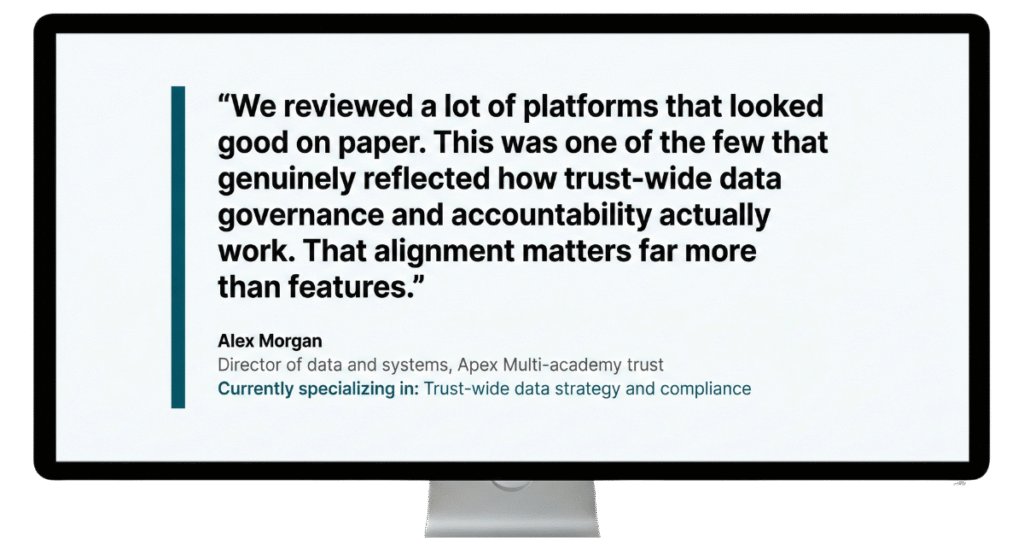
- A data director recommending a data dashboard
- A trust CFO endorsing a finance platform
- A network manager validating infrastructure or security
- A safeguarding lead commenting on compliance tooling
- A literacy specialist or established author supporting a reading scheme
- A researcher known for independent evaluation in that domain
The endorsement makes sense because the expertise maps cleanly to the product’s function.
Why teacher testimonials alone can fall short for complex school purchases
This is an uncomfortable truth, but it matters. A teacher saying “this data platform is great!” is nice, but it is not always persuasive. Especially when it’s a broader whole school investment like assessment software.
Not because teachers lack insight or influence, but because senior level school buyers know that classroom teachers are rarely responsible for system-level outcomes.
- They may not see long-term impacts
- They are not really accountable for procurement risk
- They often did not choose the product themselves
In complex school or MAT wide purchases, decision-makers subconsciously discount opinions that do not carry equivalent responsibility.
That does not mean teacher voice is unimportant. It means it should be positioned differently.
Teacher testimonials often work best when they describe lived experience, usability, or classroom-level impact. Not overall effectiveness or strategic value.
Mixing social proof types across the school buying journey
Social proof is not a single asset type. In reality, different forms of social proof do different jobs at different stages. A useful way to think about it is that teacher quotes often work well early by humanising the product and signalling classroom fit, and expert endorsements work best when commitment increases.
This is especially important in multi-stakeholder buying journeys, which describe most Trust and MAT decisions.
Data that supports this approach
There is solid behavioural evidence behind all of this. In education, uncertainty can kill a sale because outcomes are long-term, and budgets are often tight.
Research consistently shows that people rely more on authority cues when uncertainty is high.
So expertise matters more than likability in risk-heavy decisions and contextual relevance increases trust more than volume of proof.
Dr. Cialdini discusses the ‘Principle of Authority’ in his seminal book ‘The Psychology of Persuasion’ says:
“This is the idea that people follow the lead of credible, knowledgeable experts.
Physiotherapists, for example, are able to persuade more of their patients to comply with recommended exercise programs if they display their medical diplomas on the walls of their consulting rooms. People are more likely to give change for a parking meter to a complete stranger if that requester wears a uniform rather than casual clothes.
What the science is telling us is that it’s important to signal to others what makes you a credible, knowledgeable authority before you make your influence attempt. Of course this can present problems; you can hardly go around telling potential customers how brilliant you are, but you can certainly arrange for someone to do it for you.”
Common mistakes to avoid
If you have an expert endorsement, do not bury it in a carousel of quotes. Treat it as a structural element, not decorative copy, and give it significant prominence on your home page.
At the Agency, we call this “the hero quote”. High-impact placements include:
- A dedicated section on key landing pages
- A standalone slide in sales decks
- Referenced in procurement-facing documents
- Used selectively in ads targeting senior roles
Even well-intentioned teams undermine their own social proof. Some patterns to watch for:
- Overusing “headteacher” as a generic authority signal
- Quoting experts without explaining their relevance
- Using the same testimonial everywhere regardless of audience
- Treating social proof as static instead of journey-aware
- Prioritising star ratings over narrative substance
Social proof is about fit
In education, where complexity and risk shape every decision, the most persuasive product voices are often those that carry parallel responsibility.
Customers show experience and experts show judgement.
Knowing when to use each, and how to frame them, is one of the most reliable ways to improve conversion quality across your entire journey.